
States of Matter Worksheets and Properties of Matter Activities
A wooden block, a cup of water, and the air inside a balloon can get a whole class talking! These familiar examples give little scientists a way to explore solids, liquids, and gases before they put pencil to paper. If you’re planning a science unit, these states of matter worksheets and properties of matter activities will help you bring the learning together.
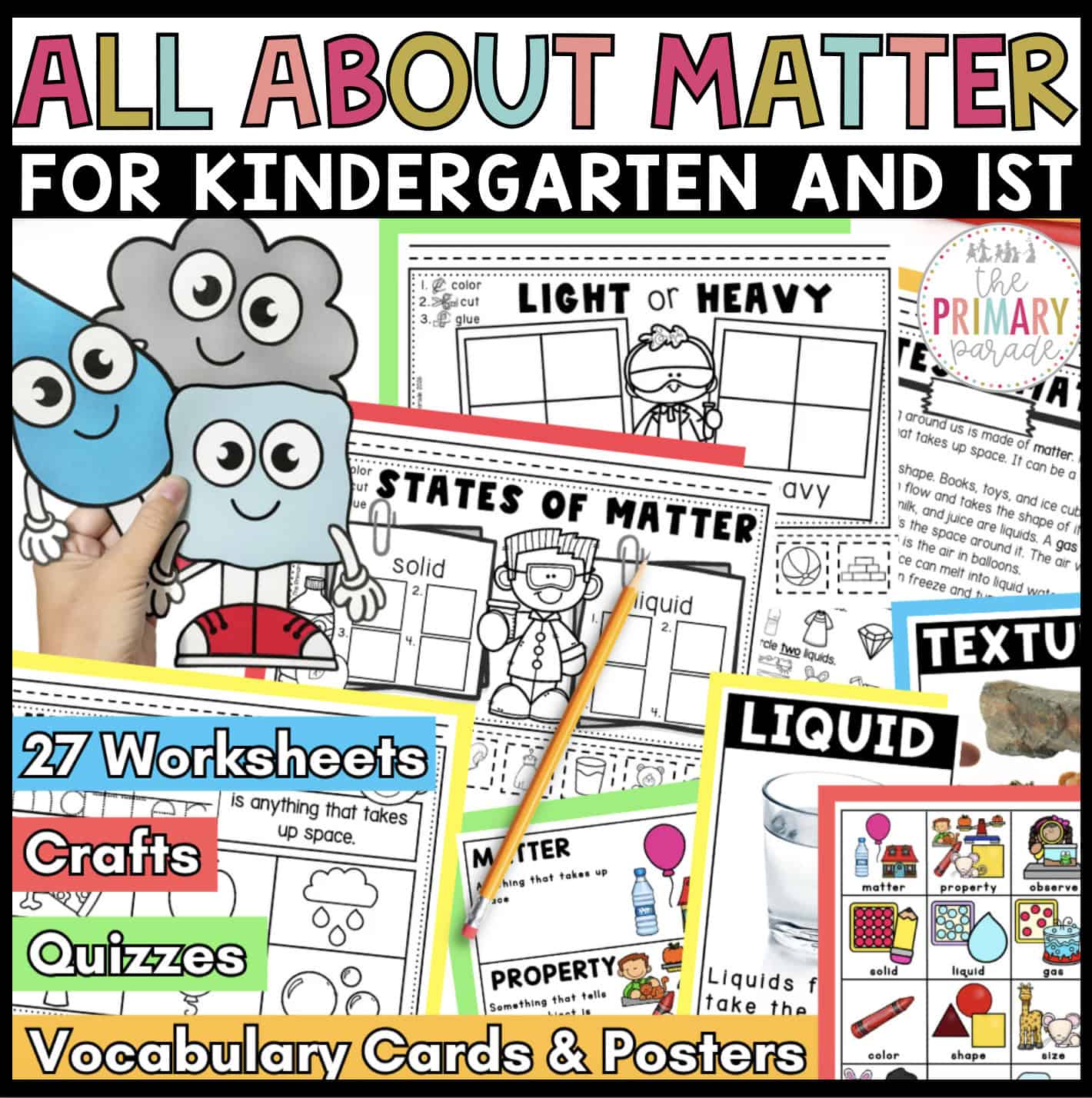
Below, you’ll find simple ways to introduce matter, explore how objects are alike and different, and follow up with printable practice. My All About Matter science activities include worksheets, vocabulary cards, posters, crafts, and quizzes for kindergarten and first grade.
What Is Matter? A Simple Explanation for Kids
Matter is anything that has mass and takes up space. For young children, start by pointing out things they can observe: their desks, crayons, water bottles, and even the air around them.
Ask, “Does this take up space?” A block is easy to see and hold, but air can be a little trickier. Inflate a balloon with a pump and compare it with an uninflated one. The air takes up space inside the balloon even though we can’t see it.
Once children have a few real examples, introduce the three states of matter you’ll explore in this unit: solid, liquid, and gas.
Teaching Solids, Liquids, and Gases in Kindergarten
Keep your first states of matter lesson simple. You don’t need lots of materials to give students something meaningful to observe. Try a classroom block, a clear cup of water, and an inflated balloon.
Solids Keep Their Own Shape
Place a wooden block on a tray and then in a cup. Ask students whether the block changed shape when you moved it. It still has its own shape! Compare it with a crayon or a rock to give children a few more examples.
A helpful follow-up question is, “Are all solids hard?” A sponge is soft and can be squeezed, but it is still a solid. This gives students a chance to think beyond the idea that solid always means hard.
Liquids Take the Shape of Their Container
Pour the same water from a clear cup into a shallow bowl. Invite children to describe what changed. The water flows and takes the shape of the part of the container it occupies.
Point out that pouring the water didn’t give you more water. Using the same amount in two differently shaped containers helps children separate the shape of the liquid from how much is there.
Gases Spread Out to Fill Their Container
Return to the balloon and talk about the air inside. Air is a mixture of gases. A gas spreads out to fill the space available in its container.
For a little movement, use a hand fan to move air toward students’ hands. Ask, “Can you see the air? Can you feel it moving?” You can use these observations to revisit the idea that matter doesn’t have to be visible.
Properties of Matter Activities: Observe, Describe, and Sort
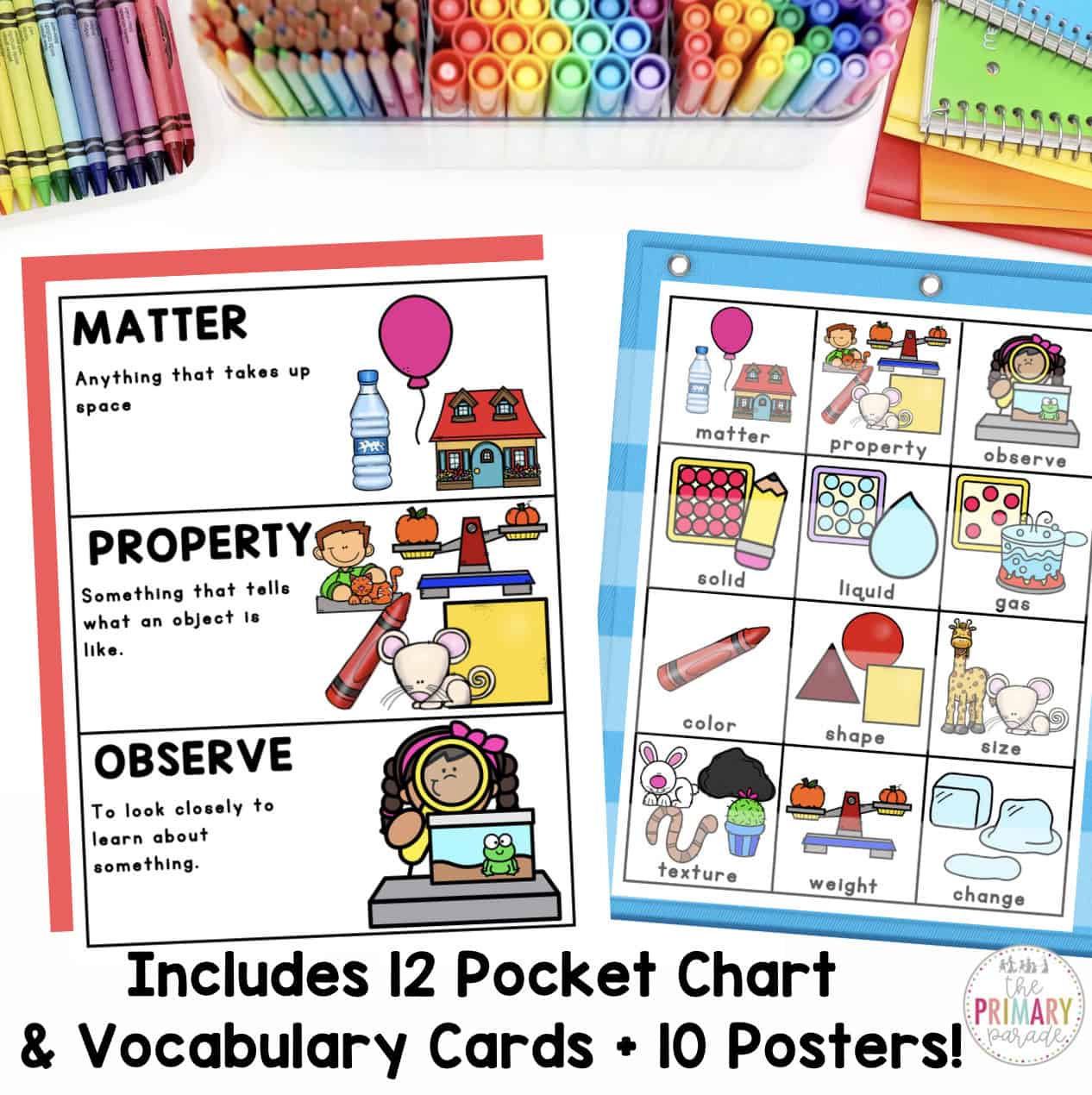
After introducing solids, liquids, and gases, take a closer look at properties of matter. Properties are characteristics we can observe or measure, such as color, shape, size, texture, and weight.
An object can have several properties at once. A block might be red, smooth, and shaped like a cube. Describing more than one property helps children notice that there are many ways to compare the same objects.
Make an Observation Tray
Gather a sponge, a smooth block, a piece of felt, and a textured piece of cardboard. Let students look closely and touch each item. Model words such as smooth, rough, soft, and firm, then invite them to describe another object.
Try a sentence frame: “I notice the ___ is ___.” Children can share their observations orally before drawing or writing about an item. The vocabulary cards and posters in All About Matter can stay nearby as a reference.
Sort the Same Objects in Different Ways
Start by asking children to sort classroom objects by color. Then mix them up and sort by size or texture. Which objects stayed together? Which ones moved to a new group?
For a weight comparison, use a balance scale and ask students to predict which of two objects will be heavier. Test the prediction together. A bigger object isn’t always heavier, so let the scale help students check their ideas.
Use States of Matter Worksheets After Exploring
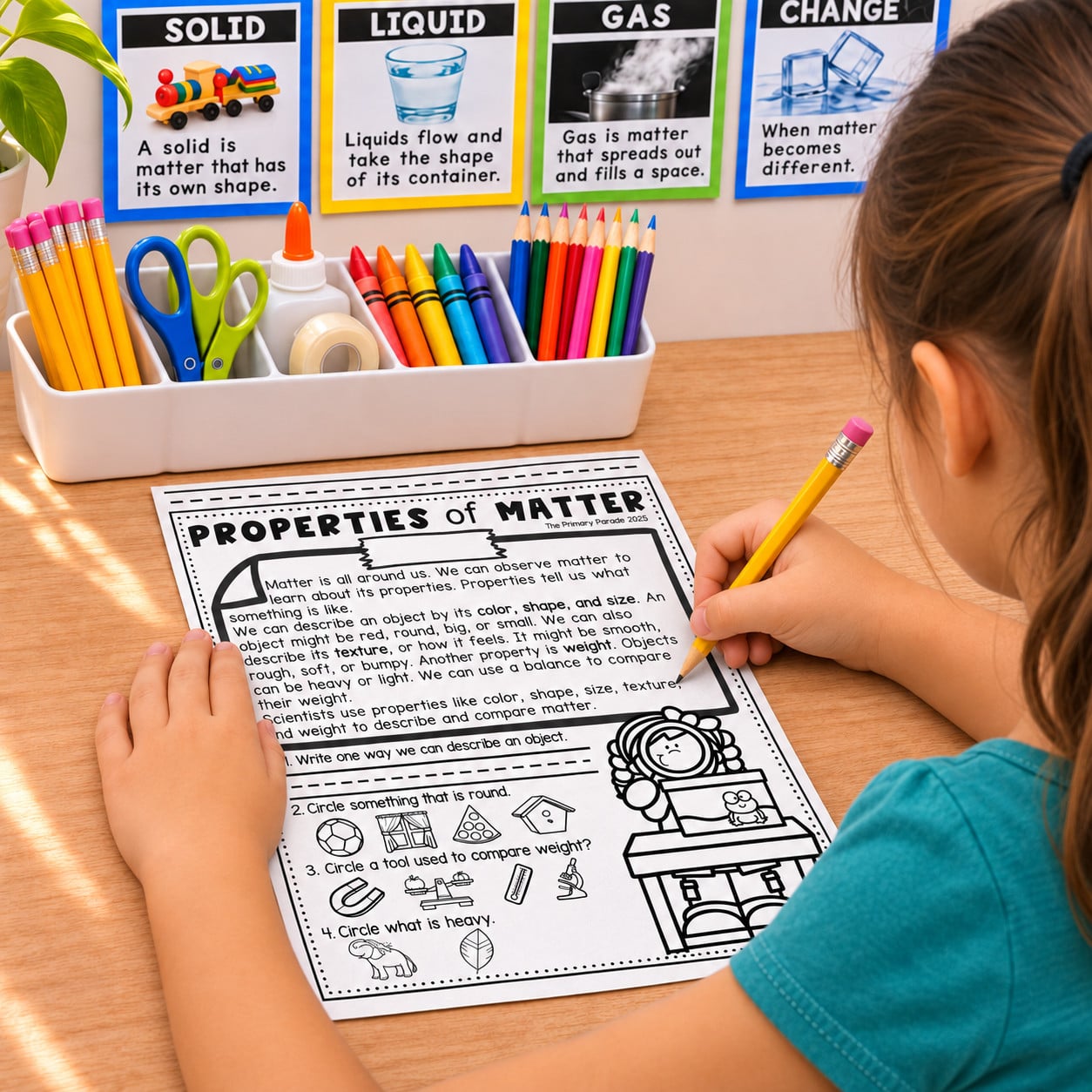
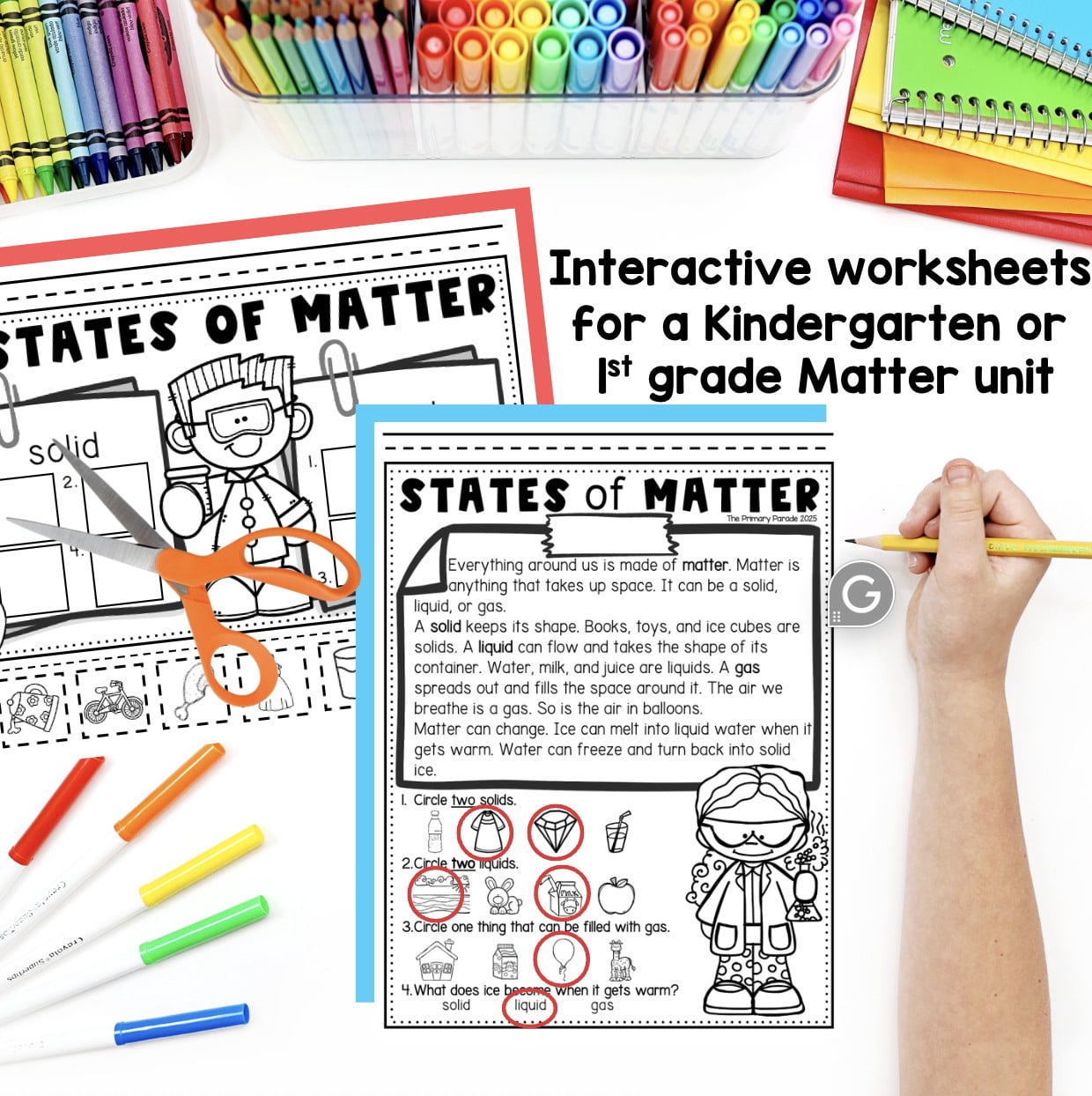
Once your students have had time to observe and discuss real examples, bring out the printable practice. My All About Matter set includes 27 worksheets for exploring states and properties of matter, along with crafts, quizzes, vocabulary cards, and posters.
Model one example together before students work on their own. As children sort or describe pictures, ask them to explain a choice: “What makes you think this is a liquid?” Their answers can tell you more than a finished page alone.
You can use the properties of matter worksheets after an observation activity, too. A light-or-heavy activity makes more sense when children have just compared objects on a balance scale. Choose the pages that fit the lesson you’re teaching rather than working through the whole set at once.
Solid, Liquid, and Gas Crafts
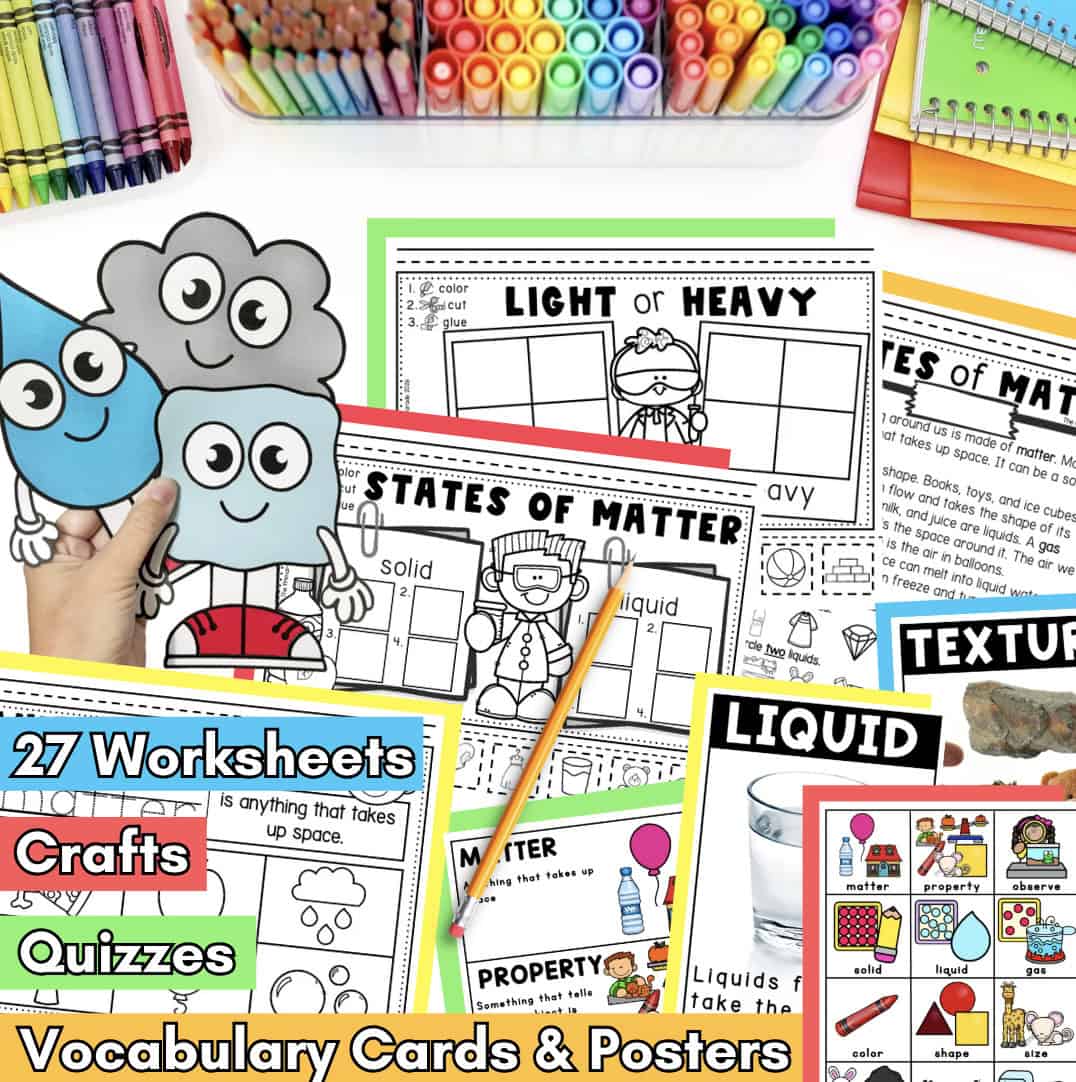
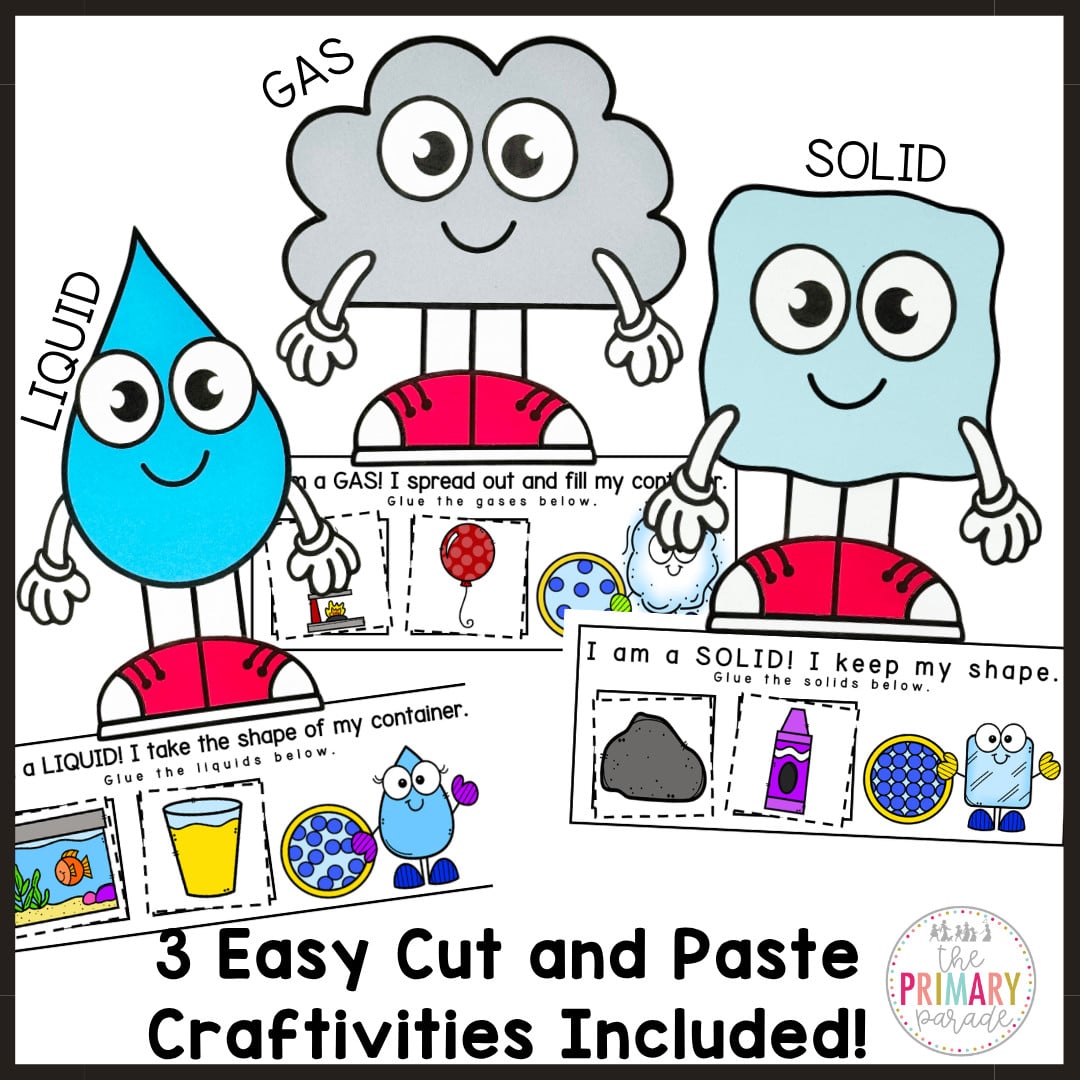
These little matter characters make a fun follow-up to your science lessons! The set includes three cut-and-paste crafts, with a character for each state of matter and pictures to sort.
Before students glue their pictures down, have them talk through their choices with a partner. Then display the finished crafts near your science area so you can refer to them during later lessons.
Build Matter Vocabulary Into Your Writing Center
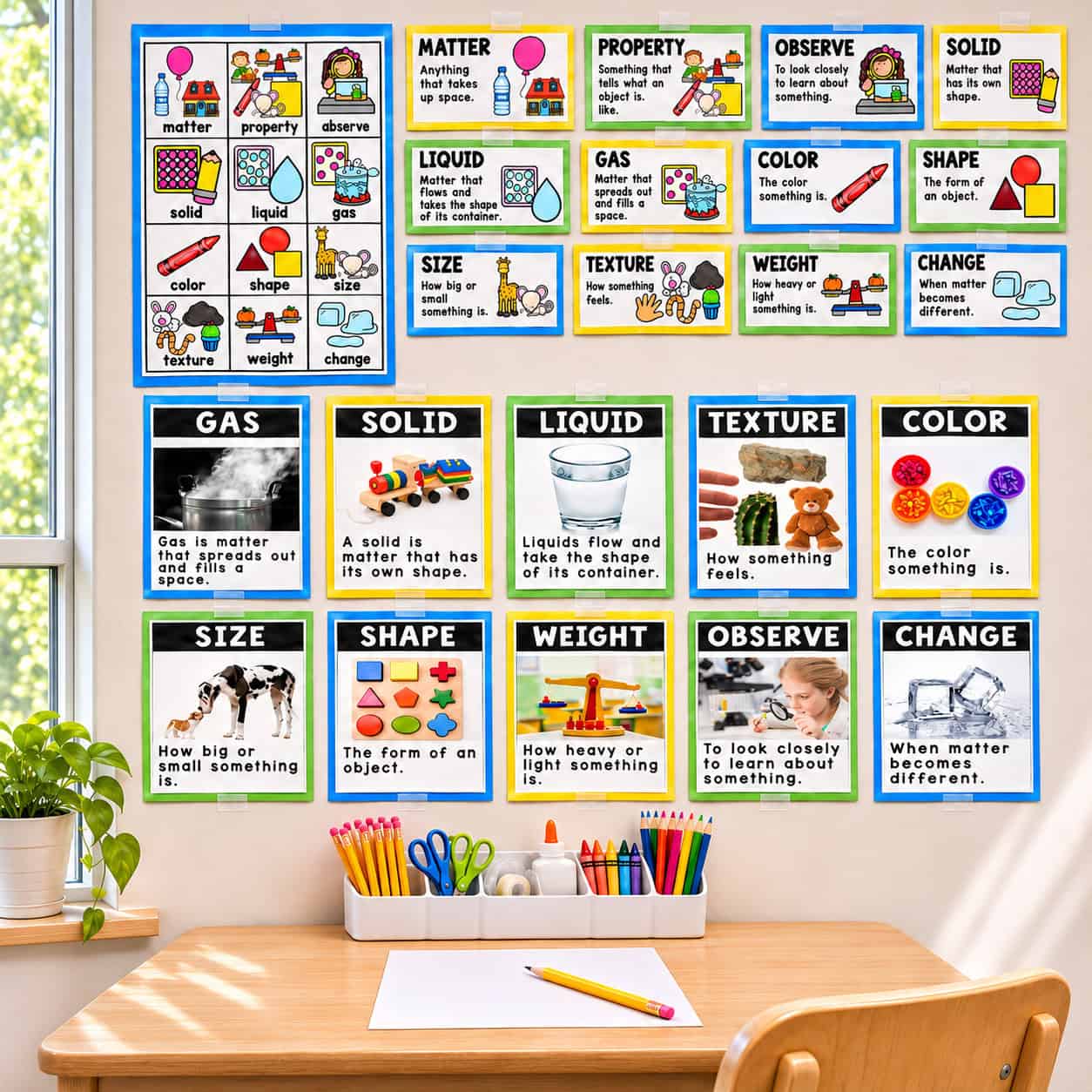
Keep the science words handy after your whole-group lesson. Add the matter vocabulary cards and posters to a writing area or science center, along with paper and pencils. Invite students to draw an example of a solid or liquid and label it.
Kindergarten students might finish “A solid is ___” with a picture and a label. First graders can add a describing sentence, such as “My block is smooth.” This connects science observations with oral language and early writing.
Check Understanding With Matter Quizzes
After several lessons, use the included quizzes to see which ideas students can apply. Read directions aloud as needed so you can focus on their science understanding.
If a student is unsure about a picture, ask a follow-up question and return to a real example. A quick demonstration with water or a block can help you decide whether the child needs more practice with the concept or just help interpreting the picture.
Questions Kids Ask About Matter
Can Something Be a Solid and Still Be Soft?
Yes! A sponge and a piece of felt are solids, even though they feel soft. Hardness is one property we can describe; it doesn’t decide whether something is a solid.
Is Air Really Matter?
Yes. Air has mass and takes up space. Return to the inflated balloon to help children connect this idea with something they have observed.
Can Matter Change From One State to Another?
Yes. Place an ice cube in a clear cup and observe it as it melts at room temperature. Children can draw what they see at the beginning and later in the lesson. The solid ice becomes liquid water.
Get the All About Matter Printables
Ready to put your matter lessons together? Grab my All About Matter States of Matter Worksheets and Science Activities set today in my shop.
Now keep the science fun going and explore more science experiments for kids for another day.
Which everyday object would your little scientists love to investigate? Tell me in the comments!


