Winter Math Activities for Preschoolers: Build a Snow Globe
Looking for hands-on winter math activities for preschoolers? Grab a few fluffy snowballs and snowflake counters! My Build a Snow Globe math center gives children a playful way to practice number recognition, counting, comparing quantities, and early addition while creating a snowy scene.
You can use the same printable mat in several different ways throughout your winter theme. Below, I’ll show you how to set up the center and turn it into three math activities: counting snowballs, comparing snowy sets, and combining groups. Start with the task that fits your learners, then add a new challenge when they are ready.
Winter Math Activities for Preschoolers with a Snow Globe
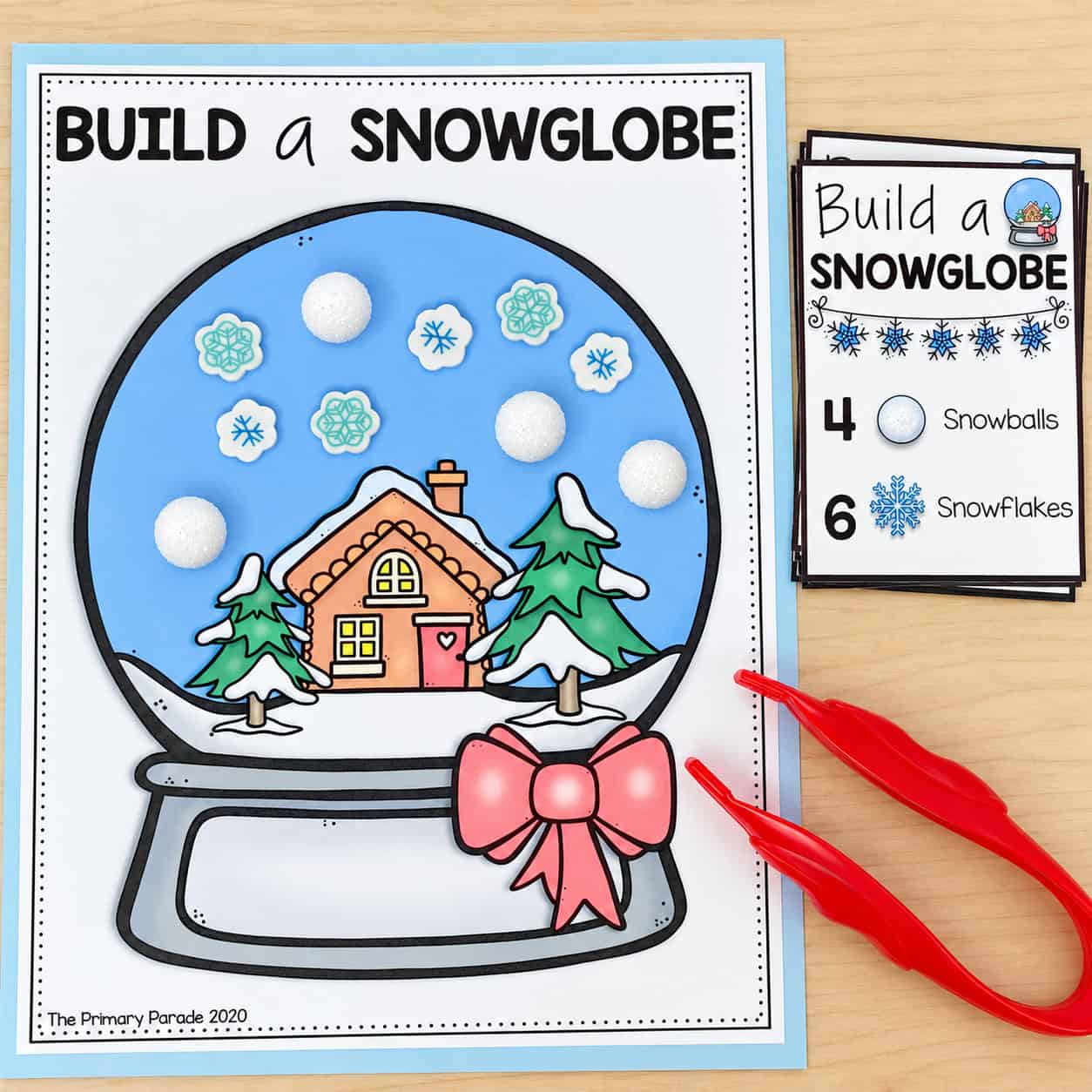
This printable center includes a snow globe mat and 15 counting cards. Each card tells children how many snowballs and snowflakes to add. The two types of objects give students a reason to look carefully at each number instead of filling the globe with any counters they choose.
I love that you can change the challenge without changing the entire activity. One child can practice counting a small group with your help, while another uses the same materials to figure out how many objects are in the globe altogether.
What You Need for Your Snow Globe Math Center
Gather your printable snow globe mat and counting cards, white pom-poms or cotton balls for snowballs, and snowflake mini erasers. If you don’t have snowflake erasers, choose a second type of counter and explain which objects will stand for snowflakes.
You can also set out child-friendly tweezers or tongs for children who want an extra fine motor challenge. Keep the counters in two small bowls so students can find each kind easily.
Print the mat and cards, cut the cards apart, and laminate them if you plan to reuse the center. A dry-erase pocket works well for the mat, too. Place everything in a tray or shallow bin so setup and cleanup stay simple.
How to Play Build a Snow Globe
Choose a card. Have your student name the two numbers and point to the snowball and snowflake pictures. Read the directions together before adding any counters.
Count the snowballs. Ask the child to move one snowball onto the mat for each number they say. Moving the objects one at a time makes it easier to keep track of what has already been counted.
Add the snowflakes. Count out the second group and place those counters inside the globe. Then check both groups against the card.
Clear the mat and try again. Return the counters to their bowls and pick another card. Children can take turns building and checking with a partner, or complete a few cards during small-group time.
For example, the card shown above asks for 4 snowballs and 6 snowflakes. A child counts four snowballs into the globe, adds six snowflakes, and checks each group. Students who are ready for an extension can count all ten objects together.
3 Winter Math Activities to Try with Your Snow Globe
Once children know how to use the mat, you can revisit it for different math skills. The counting cards guide the main game; comparing sets and joining groups are optional activities you can add with the same counters.
1. Count Snowballs and Match Numbers
Start with the snowball number on a card. Have your student name the numeral, count out that many pom-poms, and move them into the globe one at a time. Then repeat with the snowflakes. Matching a written number to a set of objects gives children a concrete way to practice number recognition.
For one-to-one correspondence, model saying one number for every object you move. If a child counts too quickly or skips an object, slide the counters into a row beside the mat and try again together. Ask, “How many snowballs are in your globe?” after counting to connect the last number said with the amount in the set.
Keep these winter counting activities manageable by choosing cards with quantities your students can count comfortably. You can also focus on just the snowballs before asking children to build both groups.
2. Compare Snowballs and Snowflakes
Build both sets from a card, then ask, “Which group has more? Which has fewer? How can we check?” Invite children to move the counters beside the mat and pair one snowball with one snowflake. Objects left without a partner help show which set has more.
For example, with 4 snowballs and 6 snowflakes, students can make four pairs and notice that two snowflakes are left over. Talk through what they see: “There are more snowflakes than snowballs.” Children who are ready can also explain that there are two more snowflakes.
To explore equal groups, set the counting cards aside and give children the same number of each type of counter. Have them pair the objects and describe what they notice. This is a teacher-created extension using the center materials.
3. Combine Groups for Simple Addition
For preschoolers who are ready to join sets, build a globe together and ask, “How many snowy pieces are there altogether?” Let children count all the objects while touching or moving each one. Keep the groups small enough for them to manage.
Tell a quick math story as they work: “Four snowballs landed in our globe. Then six snowflakes fell. How many pieces do we have now?” Students can use the objects to find the total instead of working it out in their heads.
Kindergarten students who are ready for written equations can record 4 + 6 = 10 on a separate whiteboard or piece of paper. Say the number sentence together and point to each group as you name it. You can add this recording step yourself; beginners can simply build, count, and explain.
Easy Ways to Differentiate Your Winter Math Center
For beginning counters: Choose cards with quantities your students can count comfortably. Work on one group at a time and model moving each counter as you say its number. Offer a smaller selection of cards so children can focus on the counting routine.
For students building independence: Have children read a card, build both groups, and explain how they checked their work. A partner can point to each object while they count together.
For simple addition: Invite students to combine the two groups and find the total. With four snowballs and six snowflakes, they can say, “Four and six make ten,” and write 4 + 6 = 10 on a separate whiteboard. This is an optional extension you can add when students are ready.
Tips for Using Winter Math Activities in Preschool Centers
Set up the snow globe center during your winter theme, add it to January morning tubs, or use it for a short math small group. Model one card together before placing the activity in an independent center.
For a partner activity, one child can read the card while the other builds the globe. Then have them check the two groups and switch jobs. Keeping the routine familiar lets children spend more time thinking about the numbers.
Get the Build a Snow Globe Printable
Ready to bring a little snow to your math table? Get my Build a Snow Globe counting math center in the shop, or download it through your Learning Club or All Access membership.
More Winter Activities for Preschool and Kindergarten
Keep planning with my winter activities for preschoolers and January preschool themes. For another seasonal center, try my winter syllable activities with penguin and snowman games.
Would your students choose fluffy snowballs or tiny snowflake erasers first? Set out the mat, pick a card, and let the snowy counting begin!